
You are warmly invited to a classical Tantra retreat guided by the Indian Tantra master Guruji Maharaj, offering an opportunity to experience ancient Tantric practices that have traditionally been used in spiritual Tantra to cultivate a deep connection with one’s highest self.
This retreat follows the right‑hand path of Tantra, meaning there is no physical contact between participants. All practices are designed to help you learn how to sense and cultivate your own personal energy, to expand it consciously, and to connect with your highest potential, while awakening and aligning with the Durga energy within yourself.
Guruji Maharaj has received initiations from 67 different teachers. He is a living Tantra master whose ashram is visited by students from all over the world to learn and embody these ancient mystical techniques. As Guruji has already become a deeply respected and beloved teacher to nearly two dozen Estonians, he is now visiting Estonia for the sixth time, offering a rare opportunity to personally experience the teachings of traditional Tantra under his guidance.
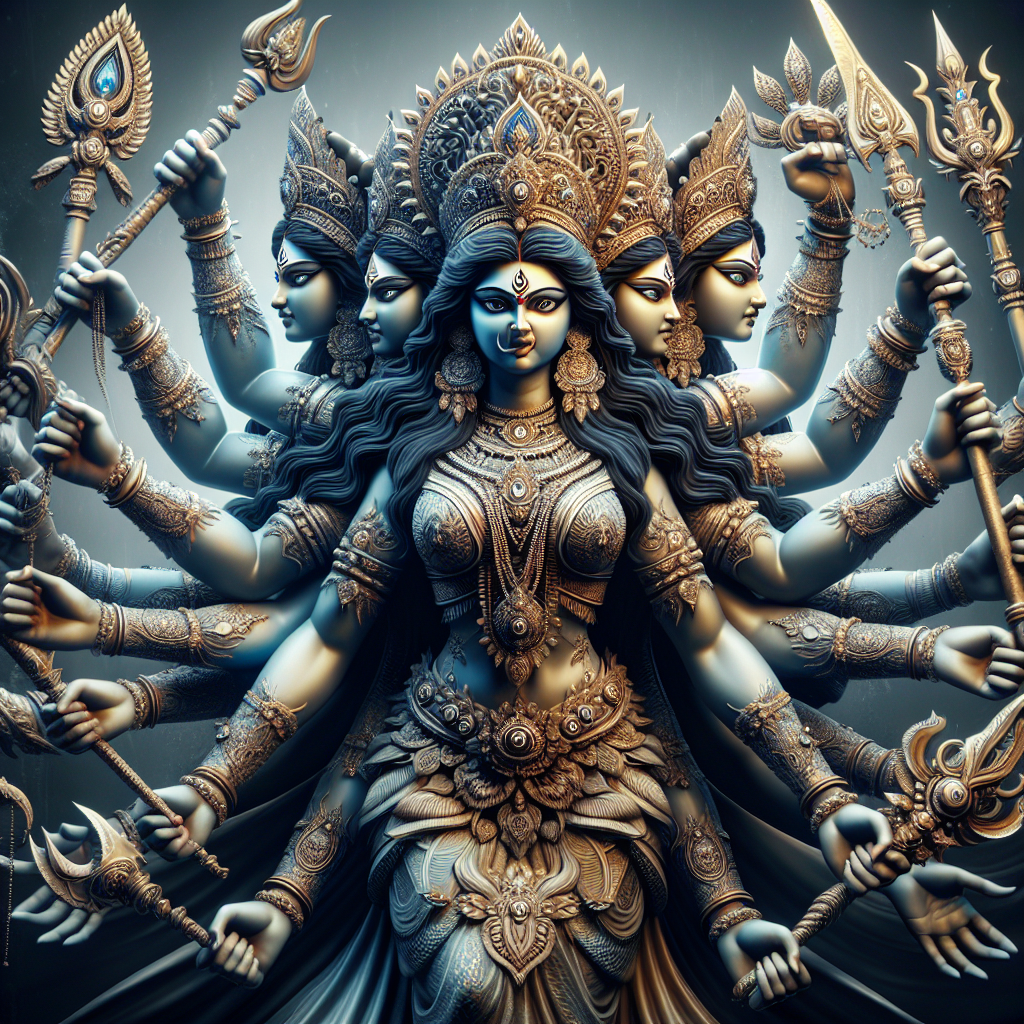
Durga (from Sanskrit, meaning “the invincible”) is one of the principal goddesses, an embodiment of Shakti — divine feminine energy and power. She is a warrior goddess, created to destroy evil and to protect the world from demonic forces.
Durga is both a fierce warrior and a loving mother. Just as a mother’s love becomes as powerful as a lion when protecting her child, Durga awakens within us an extraordinary inner strength that allows us to walk our own path under divine protection. Her lion mount symbolises limitless power held in perfect control. Honouring Durga teaches us that each of us carries the strength to stand up to injustice and to remain true to ourselves — provided we are willing to gather and trust our inner power and wisdom.
Retreat Participation Details
Over the course of three days, you will take part in the following practices:
- Yantra — a purification process working with sacred geometry
- Yagna — a fire ritual for connecting with mantra
- Japa — mantra meditation practices
- A personal, private meeting with Guruji, where you may ask questions that are important to you on a personal and spiritual level.

Retreat Fee
- Until 5 April: €360
- From 6 April onwards: €430
Koha tagamiseks tasu tagastamatu ettemaks 200 eurot:
arveldusarvele EE327700771007082431 (LHV),
saaja: Margus Sarmet,
selgitusse: „Retriidi osalus“.
Teine osa tasutakse sularahas kohapeal.
Guru Dakshina
Traditionally, each participant offers a donation (dakshina) to the Guru on the final day, guided by their own inner sense. The Guru’s teachings are not included in the participation fee; the retreat fee covers only the organisational and practical costs of running the workshop.
What the Retreat Fee Includes
- Accommodation for the duration of the retreat in modest shared spaces, using your own sleeping equipment
(participants who prefer more privacy may also bring their own tent) - Vegetarian meals twice a day
- Guided practices and meditations, sharing circles, and devotional singing
- A meeting with Guruji
(an energetic assessment is available for an additional fee)
Optional Additional Offering
For an extra fee, it is possible to book an energetic assessment with Guruji, during which participants may receive insight into:
– the current state of their kundalini energy,
– the presence or absence of energetic blockages, and
– the cosmic energy or Ishta Devata with which the participant has a direct connection.
Community‑Based Retreat Experience
The retreat is organised according to community principles. Participants prepare food together, take care of daily practical matters as a group, and gather in the evenings for sharing circles and uplifting mantra chanting. The idea of a spiritual family is a central element of Guruji’s teachings.
The event will be held primarily in English.
More information about Guruji can be found at:
www.shivohamtantra.com
Retreat location: Lingavere, Voose village, Harju County, Estonia.
To participate, please complete the registration form linked to the event.
For additional questions, you may call +372 5567 2027 or email us at kristiinale@yahoo.com.
You are warmly welcome — no prior experience is required.
The Legend of the Defeat of Mahishasura
This myth originates from the ancient text Devi Mahatmyam and symbolises the universal struggle between light and darkness.
The seemingly invincible demon Mahishasura, half man and half buffalo, had received a boon from the creator god Brahma: he could not be killed by any man or god. Considering women weak, he believed himself immortal. He attacked the heavenly realms, overthrew the gods from their thrones, and spread terror throughout the worlds.
In despair, the gods — led by Shiva and Vishnu — gathered together. Unable to defeat the demon individually due to Brahma’s boon, they united their anger and spiritual power. From their combined energy arose a blinding mass of light, from which Durga took form.
Each god gifted Durga their most powerful weapon:
- Himalaya, king of the mountains, gave her a majestic lion as her mount
- Shiva bestowed his trident (trishula)
- Vishnu gave his divine discus (chakra)
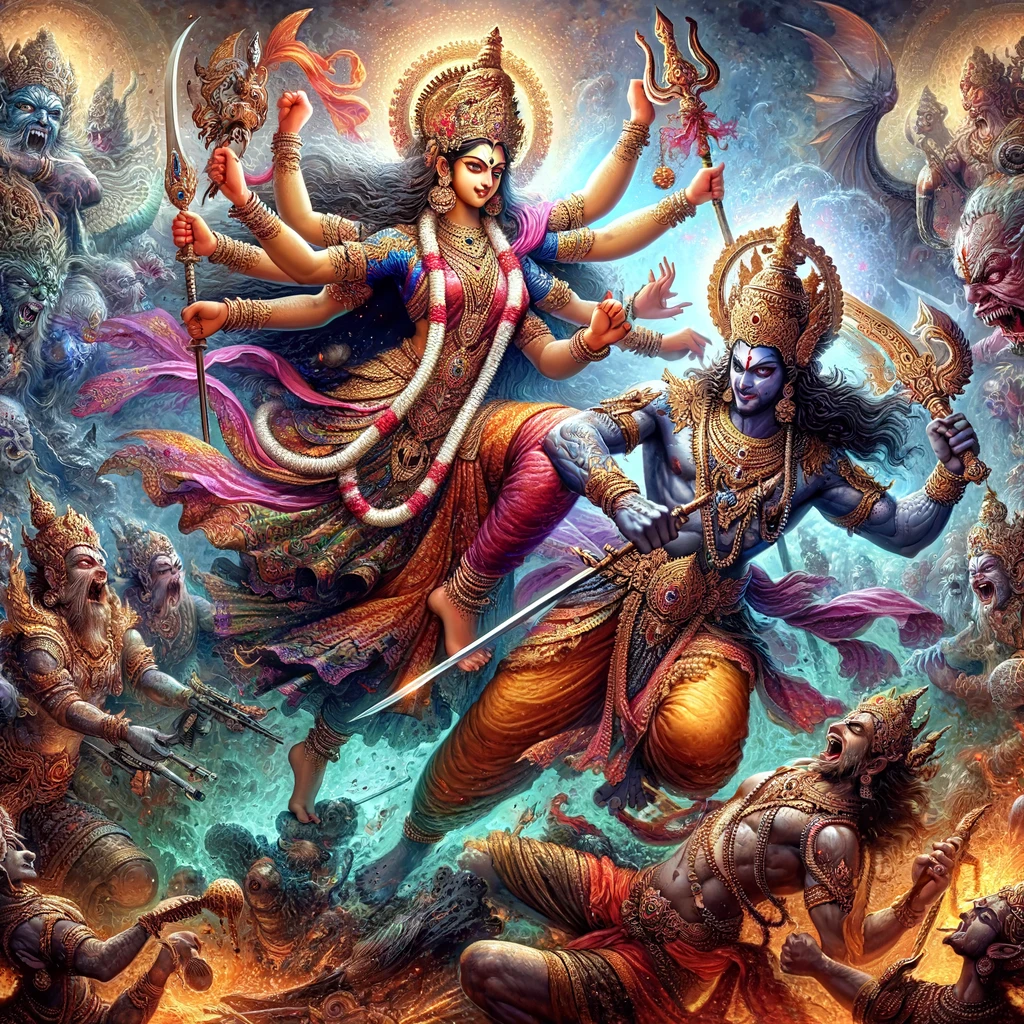
Riding her lion, Durga advanced toward Mahishasura, her battle cry shaking the earth. Shocked by her power, the demon repeatedly changed his form — becoming a lion, then an elephant, and finally returning to a massive buffalo.
The battle raged for nine days and nights. Mahishasura attempted to confuse Durga with magic and transformation, but the goddess remained unwavering. On the tenth day, as the demon charged once more in buffalo form, Durga leapt upon him, pinned him beneath her foot, and thrust her trident into his chest. At the very moment the demon attempted to emerge from the buffalo’s body in his true human form, Durga severed his head with her sword, bringing an end to his reign of terror.
This victory symbolises the triumph of awareness and light over ignorance and ego.
Symbols of Durga
The weapons held in Durga’s hands are not merely instruments of battle; they represent spiritual qualities that a human being needs in order to overcome their inner “demons”:
- Shiva’s Trident (Trishula)
Symbolises the three fundamental qualities (gunas) — creation, preservation, and destruction. It reminds us of the need to find balance between our physical, mental, and spiritual selves. - Vishnu’s Discus (Chakra)
Spinning around Durga’s finger, it symbolises that the centre of the world is dharma — duty, righteousness, and moral order. It teaches that justice ultimately prevails over injustice. - Indra’s Thunderbolt (Vajra)
Represents unwavering strength and determination. Just as lightning can shatter stone, so must inner spiritual power be fearless and unbreakable. - Varuna’s Conch (Shankha)
Its sound symbolises the primordial universal vibration “Om”. It represents the connection with the divine and the creative force of life itself. - Agni’s Flame / Spear
Symbolises knowledge and illumination. Fire burns away ignorance, leaving only truth behind. - Vayu’s Bow and Arrows
The bow represents potential energy, while the arrow represents kinetic energy. Together they signify focus and purposeful action — the ability to aim precisely at one’s spiritual goals. - The Lotus Flower
Although not a weapon, Durga is often depicted holding a lotus. It symbolises spiritual awakening and purity that arise even amidst the mud and challenges of the world. - The Sword
Symbolises wisdom and sharp discernment, cutting through ignorance and the bonds of ego.